Skip to content
← All issues
THE H.O.T. TAKE · ISSUE 03 · NOVEMBER 20, 2026

Rewrite the rules.
Which ones still run the old work?

Each weekday we read one AI story where people, organization and technology meet, and end with one thing to try on a single workflow on Monday. Once a week, the best of them arrive here.

Three stories this week, one pattern. Gallup finds AI is moving people's time toward checking work and learning, while meetings stay put. In Fortune, board adviser Louisa Loran argues that old rules and incentives, not the tools, are holding AI gains back from profit. Uber checks every agent action against the intents its owner allowed. The work has already moved; the rules around it have to be rewritten on purpose, or the old ones keep running it.

Below them: the week in five numbers, six more reads across Human, Organization and Technology, the latest Moonshots episode, and one question to take into Monday.

THIS WEEK IN NUMBERS

Where the work moved first.

80%

of employees feel more productive from AI. Only 37% of companies see it in profit. FORTUNE →

1 in 5

frequent AI users now spend more time reviewing output or learning new tools, while meetings have barely moved. GALLUP →

About 1 in 3

managers and executives trust AI over their own judgment on work decisions, against 16% of other staff. CHARTER →

2×

Cisco's people are twice as likely to use AI when their direct leader does. CISCO →

3,100

small agents built by Security Bank staff for their own work, after more than 3,000 were trained in agentic AI. SECURITY BANK →
THE H.O.T. TAKE · THIS WEEK

One episode, three takes. One move each for Monday.

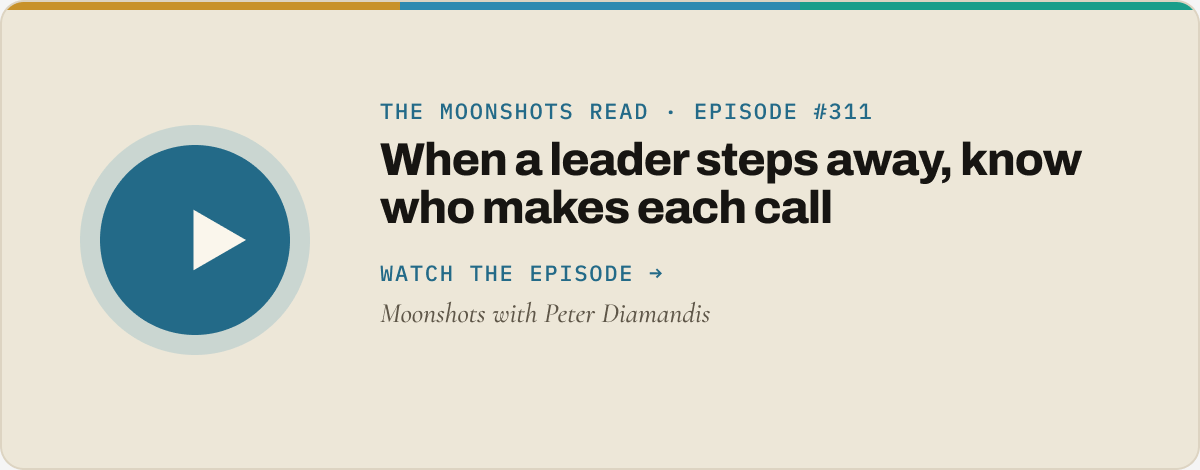
THE MOONSHOTS READ · EPISODE #311
Watch Moonshots #311: When a leader steps away, know who makes each call

Moonshots #311 spends a long stretch on Jensen Huang's departure from NVIDIA and who could replace him, with Emad Mostaque joining Peter Diamandis, Salim Ismail and Alexander Wissner-Gross. This week's move starts from that conversation.

OUR READSuccession is usually treated as a question about one person at the top, but the same gap opens every week in every workflow, whenever the usual decider is out. Agents make it sharper, because an agent that doesn't know where to escalate either stalls or guesses. So start with the organization: write the backup decision rights down before the absence, not during it.

ON MONDAYIn one workflow, write down who makes each decision when the usual decider is out, and check that the agents in it know where to escalate.

WATCH THE EPISODE →Moonshots with Peter Diamandis · Nov 13, 2026 ↗

HUMAN
where judgment goes

Gallup: AI moves people's time to checking work and learning, while meetings stay put

Gallup finds that frequent AI users spend less time gathering information and drafting, about one in five now spend more time reviewing output or learning new tools, and meetings and collaboration have barely moved.

ON MONDAYPick one workflow and decide on purpose where the freed hours go, including who reviews the AI's work and what the new output expectation is, before pressure sets it for you.

Gallup · Nov 16, 2026 ↗

ORGANIZATION
who holds the authority

Old rules and incentives, not the tools, are holding AI gains back from profit

In Fortune, board adviser Louisa Loran argues that AI's productivity gains stall before profit because past decisions have hardened into rules and incentives still reward the old way of working.

ON MONDAYList the rules one workflow runs on, ask what each was protecting, keep only the legal, safety and capacity limits fixed, and tie part of the team's target to the shared result.

Fortune · Nov 16, 2026 ↗

TECHNOLOGY
where the limits hold

Uber checks each agent action against the intents its owner allowed

Uber registers every AI agent with a named owner, its permitted intents and its constraints, then checks each proposed action against that record before it runs and keeps a trace that can be replayed when policies change.

ON MONDAYWrite down for one agent in one workflow who owns it and the few things it is allowed to do, because explicit, per-agent limits are the control Uber leans on most.

InfoQ · Nov 15, 2026 ↗

EVERY TAKE ON THE SITE →

ALSO THIS WEEK

Six more reads. One move each.

Two per strand. Each one is on the site in full, with its source.

HUMAN
where judgment goes

Charter: leaders trust AI over their own judgment twice as often as staff

Charter's survey of 5,002 U.S. desk workers finds about a third of managers and executives trust AI over their own judgment on work decisions, against 16% of other staff, and leaders are more likely to act on output they doubt.

ON MONDAYPick one leadership decision that leans on AI, such as a budget call, and have it name the colleague with context who checked the output before it goes ahead.

Fortune (Charter AI Pulse) · Nov 16, 2026 ↗

HUMAN
where judgment goes

HiBob: HR uses AI to send promotion calls back to managers, and finds overlooked people

In HiBob's survey of HR teams, 57% of those using AI reviews say it led them to reconsider someone first passed over for promotion, and 73% have used it to get a manager to rethink a proposed decision.

ON MONDAYTake one people decision, keep the manager as the one who decides, and add an AI second read that HR can use to ask what was missed before it is signed.

HiBob (GlobeNewswire) · Nov 12, 2026 ↗

ORGANIZATION
who holds the authority

Cisco pairs its AI power users with senior leaders, the users as mentors

Cisco says its people are twice as likely to use AI when their direct leader does, so it pairs employee AI super users with senior leaders as their mentors and gives every employee four hours a month to learn.

ON MONDAYPair the person who runs one workflow best with AI with the leader who owns that workflow, and let the expert propose the next change to it.

Fortune (with Great Place To Work) · Nov 12, 2026 ↗

ORGANIZATION
who holds the authority

Tencent moves half its staff into AI-native units, some with no management layer

Tencent told staff at its anniversary town hall that half the company will move into new AI-native businesses, some run as flat teams with no management layer above them, and says this is reassignment, not layoffs.

ON MONDAYPick one workflow, count how many sign-offs a decision passes through today, and test what changes when the person doing the work and the agent beside them answer straight to the person who owns the outcome.

Seoul Economic Daily (via Yicai) · Nov 13, 2026 ↗

TECHNOLOGY
where the limits hold

Security Bank staff have built 3,100 agents, with more human review as stakes rise

Security Bank in the Philippines has trained more than 3,000 employees in agentic AI, and they have built about 3,100 small agents for their own work, while credit, fraud, risk and complaints decisions keep more human judgment and controls.

ON MONDAYLet the people in one workflow build the agent for its routine steps, and write down the point where a person still reviews before anything leaves the team.

The Philippine Star · Nov 15, 2026 ↗

TECHNOLOGY
where the limits hold

Databricks lets each agent's author choose exactly which tools it can use

Databricks' Genie Agents can now read documents and act in Slack, Gmail and other tools, with the person who builds each agent deciding which tools it may touch, and General Motors runs more than 1,000 of them, each grounded in one line of business.

ON MONDAYList what one agent in a single workflow is allowed to do, cut it to the fewest actions the job needs, and put the name of the person who set those limits beside it.

Databricks · Nov 11, 2026 ↗

A QUESTION FOR YOUR LEADERSHIP TEAM

Which of your rules were written for work that AI now does?

In Fortune, Louisa Loran argues that AI's gains stall because past decisions have hardened into rules and incentives that still reward the old way of working. Pick one rule a workflow runs on and ask what it was protecting. If nobody knows, start there on Monday.

Where does your organization stand?

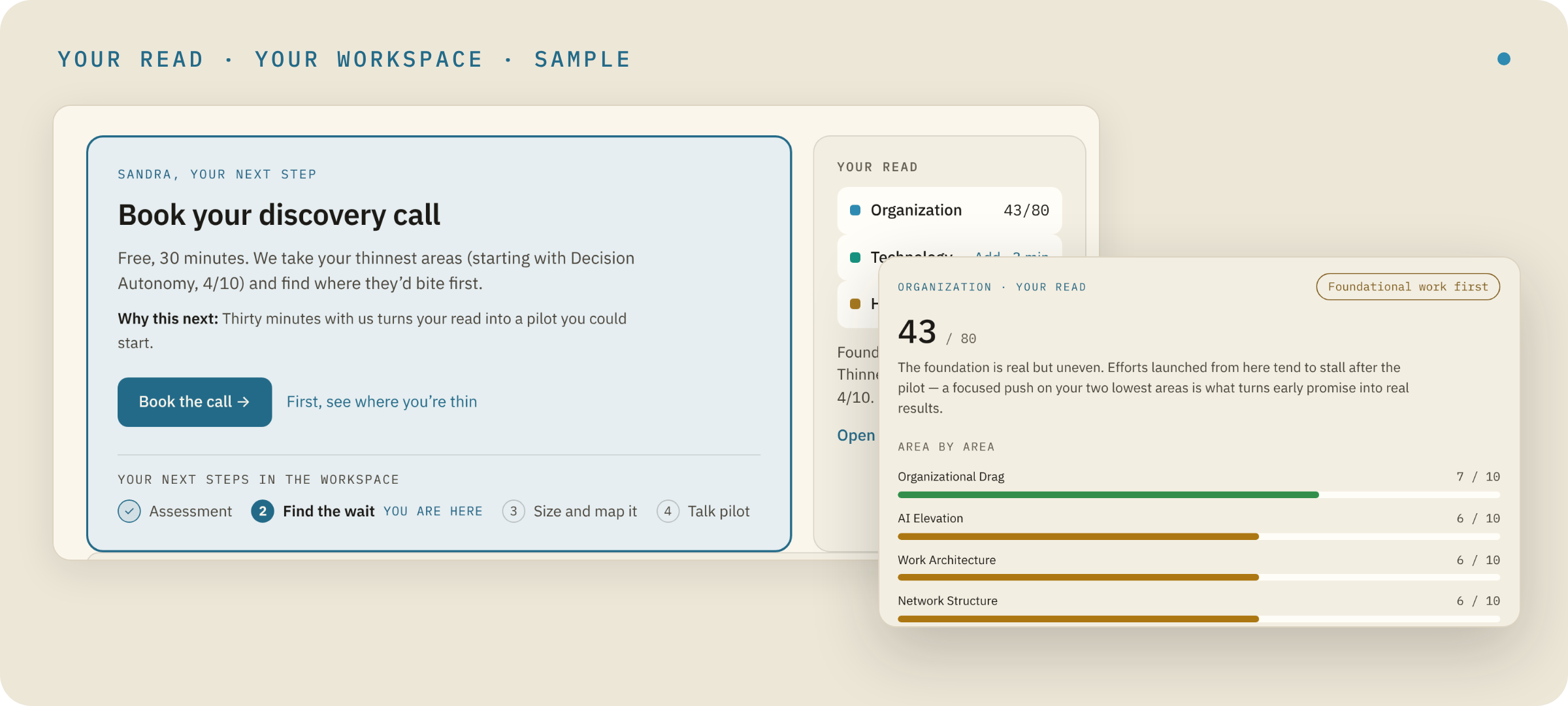
The H.O.T. Readiness Scan reads Human, Organization and Technology separately and returns a shape, not a grade. Free; your email opens it.

A sample read and free workspace: your organization's areas scored, and your next step
Assess your organization →OR CREATE YOUR FREE WORKSPACE →
Get The H.O.T. Take every Friday.

The week's best takes, one email.

The H.O.T. Take is Pegasus Collective's independent commentary. Sources are linked, not reproduced, and the words are ours. References do not imply endorsement. ExO 3.0 frameworks are by Salim Ismail and OpenExO.

HUMANORGANIZATIONTECHNOLOGY

Thrive in a world of exponential change.