One system, not three projects.
Every AI transformation runs through people, the organization and the technology. Most companies hand those to three different firms, on three schedules. The work stalls in the gaps between them. That gap is the reason Pegasus Collective exists.
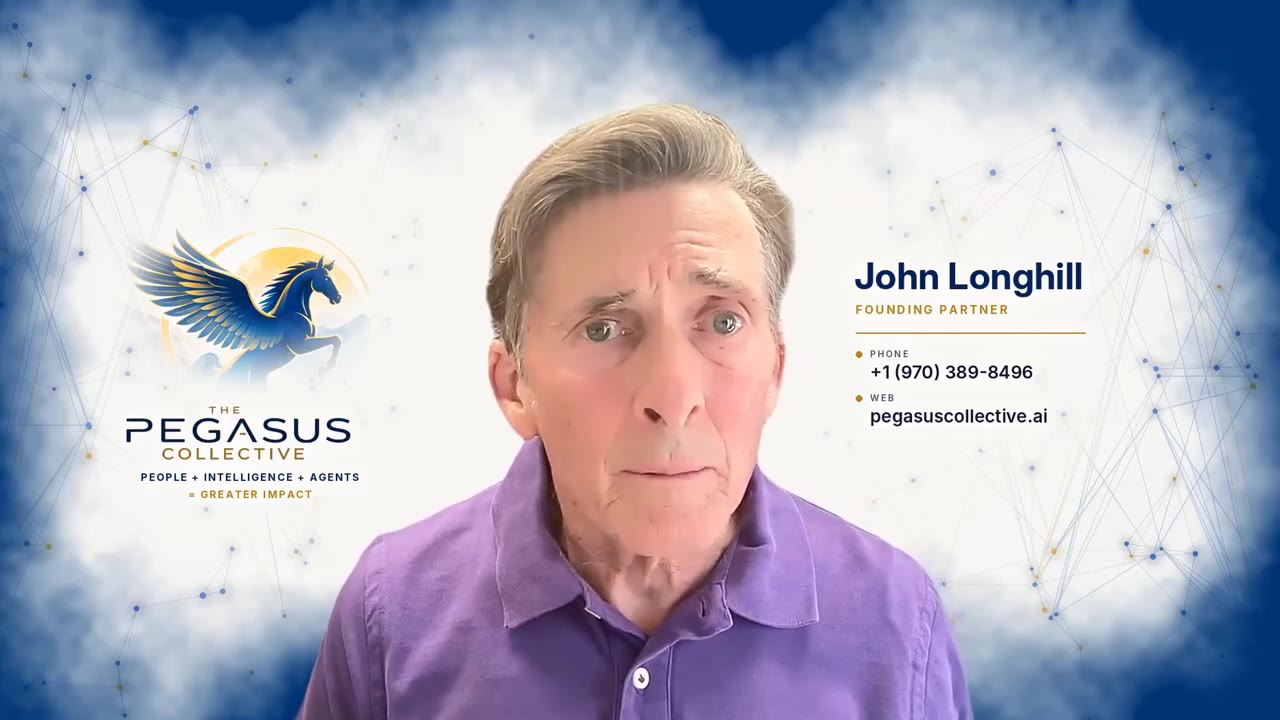
“They’re one system. They’re not three distinct projects.”
“You fix one layer alone and the other two drag it back. And that’s why Jani, Reggie and I formed Pegasus Collective: to work those three together, fill those gaps.”
From Be Unbelievable on Now Media TV
Almost everyone is using it. Almost no one is getting paid for it.
The technology works. That is the strange part. Organizations have bought it, piloted it and put it in front of their people, and the numbers keep telling the same story from every direction: adoption is nearly universal, and the return has barely moved.
organizations use AI in at least one business function. Barely a third can point to any bottom-line impact, a share that hasn’t moved in a year.
McKinsey, The State of AI in 2026of agent pilots never reach production. IDC’s own reading: a low level of organizational readiness, not model quality.
IDC, via The Seamof enterprises run agents in production, against the 9% that have changed how they operate around them.
Genpact, Nov 2026, via The H.O.T. Takerun fully autonomous agents in production. About 40% of firms that measured their AI savings landed below 10%, and 90% are raising AI budgets anyway.
Bain & Company, n=951, via One Move, Three FacesNone of these is a story about weak models. Each one is the same gap seen from a different side: the tool can do far more than the organization is built to receive. The capability arrived. The readiness to use it did not.
The effort sits where the budget doesn’t.
BCG’s 10-20-70 rule describes where the effort goes in AI transformations that work: about 10% into the algorithms, 20% into the technology and data, and 70% into people and process. It describes effort, not value, and most AI plans are built from the other end, starting with the model and the tooling.
the revenue, for startups shown how other firms had reorganized their work around AI. All 515 in the experiment had the same tools, training and support.
2026 field experiment, 515 high-growth startups, via Whylower profit margins at companies outside tech that added AI to unchanged work, compared with companies that never started.
MIT FutureTech, S&P 500 adoption study (associations, not proof of cause)of actual work on an insurance application that spent 22 days in process. Double the speed of every step and it still takes about 22 days.
Michael Hammer, HBR 1990, as compiled by Social Capital, 2026Same tools, different organizations, different results. What separated them was how the work was arranged around the technology. In John’s words from the same interview: technology multiplies whatever it finds. Make a broken process ten times faster and it is still the wrong process.
Three firms, three schedules, and the seams between them.
Look at how most organizations buy change. A strategy firm redesigns the organization. A technology firm installs the systems. A change consultant works with the people. Each brings its own plan, its own budget and its own calendar, and each is good at its part.
The problem is the hand-offs. Run the three in sequence and each passes the work to the next, losing tension at every seam. John gives the example of a manufacturer where new AI scheduling runs straight into three-signature approvals and supervisors keeping their own spreadsheets. The platform is ready. The organization can’t decide fast enough to use it. And the people were never asked whether they were ready at all.
One decision, three faces.
It is tempting to treat the people, the structure and the platform as three problems that happen to interact. They aren’t. In One Move, Three Faces, Reggie Britt locates them in a single place: the seam where an agent works, the line between what it may propose and what the organization will permit.
That one line is three things at once. Someone’s judgment decided what good looks like and what must escalate. The organization’s authority granted this agent this much scope and no more. And the platform enforces it, at machine speed, with a record of who did what. Miss any one and the capability leaks, either into risk no one can see or into value no one captures.
That is why the familiar failure is so consistent. A pilot that impresses and changes nothing is almost always a machine with two of the three built. The failures of the AI era are what it looks like to run one move in pieces, by people each holding a third of the answer.
The same evidence keeps arriving in our daily read. Avanade found most firms calling themselves AI-mature while few had changed how their teams work. Payscale found jobs rewritten for AI while pay stayed put. Korn Ferry found managers carrying the change while few leaders felt ready to lead it. Each time, one strand moved and the other two didn’t.
Almost no one holds all three in one head.
Seeing the people, the structure and the platform as one object takes three kinds of experience at once, and they rarely live in the same career. So we didn’t try to find one person who held all three. We put three practitioners on one move.
We work the three together: the human change designed against the structure it will live in, the structure designed against the platform that must carry it, and the platform designed around the people who will use it. No hand-offs between vendors, and no strand left to catch up later.
The organization dimension runs on ExO 3.0, the published methodology from Salim Ismail and OpenExO that we build on. H.O.T. extends it with equal depth on the two dimensions most programs treat thinly: the people and the platform.
Smaller, done whole.
The answer to a three-sided problem isn’t a bigger program. It’s a smaller one, done whole. We start with one workflow, rebuilt beside the process that runs today, and prove it against measures agreed before anything scales.
- The people who will supervise the agents are named and ready before anything runs unattended.
- The organization writes down who decides each step the agents carry, and who answers for it.
- The technology holds the line: a named owner, a stop control, a record of every action and a clean way back.
Three strands, one workflow, one schedule. Then the organization decides, on its own numbers, whether to extend it.
If you scored your people, your structure and your platform separately today, which would be furthest behind?
The H.O.T. scan reads all three against published anchors, in about ten minutes, in a free workspace that keeps the result.
Sources: McKinsey, The State of AI in 2026. IDC, agent pilot-to-production conversion, as cited in Reggie Britt, The Seam. Genpact, enterprise agent survey, November 2026. Bain & Company, Automation and AI Pathfinder Survey 2026 (n=951), as cited in One Move, Three Faces. BCG, the 10-20-70 rule. A 2026 field experiment with 515 high-growth startups (ten weeks). MIT FutureTech, AI adoption in S&P 500 firms. Michael Hammer, “Reengineering Work: Don’t Automate, Obliterate,” Harvard Business Review, 1990, as compiled in Social Capital’s AI ROI deep dive, September 2026. ExO 3.0: Salim Ismail and contributors, OpenExO. Video: Be Unbelievable, Now Media TV.